Showing posts with label city management. Show all posts

Monday, January 26, 2015

REPOST: What Your Personality Has to Do With Your Neighborhood

Could certain parts of a city attract people with similar personalities? New research on geographic clustering suggests they do, data that can significantly impact the future of zoning, tourism, urban planning, and city management. This article from Citylab.com has the details:

Image Source: citylab.com

It’s a well-worn sociological truth that the neighborhoods in which we live can have a powerful effect on our lives. But how do our neighborhoods affect our overall happiness and well being? And what might they reflect about our underlying personalities?

A new study published in the prestigious Proceedings of the National Academy of Sciences (PNAS) by an international group of psychologists, including Markus Jokela, Samuel Gosling and Peter J. Rentfrow, takes a detailed look at the intersection of personality and happiness in London. While a growing number of studies trace the happiness of cities and metro areas, and a few have considered the geographic clustering and concentration of personality traits, there has been much less research on the clustering of personality types within cities and the effects of neighborhood location on happiness.

The study explores the neighborhood clustering of the five basic personality traits defined by the classic five-factor model: openness to experience, extraversion, agreeableness, conscientiousness and emotional stability (or lack of neuroticism). The researchers then examined the clustering of these personality traits and their effects on individuals’ happiness based on an online survey of some 56,000 people in the London metro area. They define neighborhoods by postal districts, of which there are 219 in London.

There has been much less research on the clustering of personality types within cities and the effects of neighborhood location on happiness.

The maps below, from the study, show the clustering of the five personality types across metro London. The sixth map, on the bottom right, shows the concentration of neighborhoods by happiness or life satisfaction. Red indicates high concentrations of a certain personality trait or of satisfaction, while blue indicates a cluster without that trait.
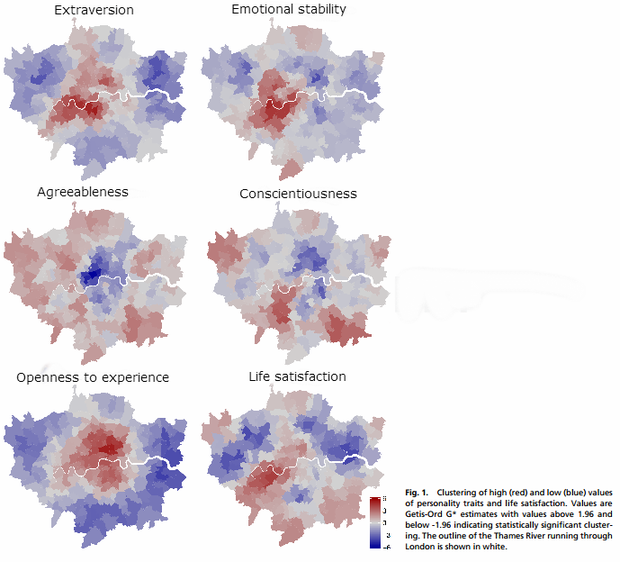
Image Source: citylab.com

The most clustered personality trait the researchers found was “openness to experience” (bottom left map), which is concentrated in the center of London. Openness to experience, according to a wide body of psychological studies, is associated with creativity, innovation and entrepreneurship. This type is concentrated in higher density neighborhoods, with higher housing prices, more ethnic and religious diversity and higher crime rates. Meanwhile, the blue concentrations at the periphery indicate that there are fewer people open to experience in metro London’s suburbs.

Extroverted types also cluster near the center city (top left map), though not in the concentration levels seen for openness to experience. Since extroverts want to connect to other people, it makes sense that they are attracted to denser neighborhoods with greater concentrations of meeting places like restaurants and bars. There is an absence of extroverts at the outskirts of the city. Two types—agreeableness (middle left) and conscientiousness (middle right)—are concentrated in outlying suburban areas.

The last map plots life satisfaction. Unsurprisingly, the map roughly tracks the distribution of wealth throughout metro London, with happier residents generally clustered in the most well-to-do neighborhoods and those with lower levels of life satisfaction concentrated in areas of greater poverty and those with higher concentrations of ethnic minorities. The study finds that neighborhood characteristics accounted for two-thirds of the variance in happiness across neighborhoods, indicating, as the researchers write, “a substantial link between sociodemographic factors and average life satisfaction of neighborhoods.”

Living in densely populated, ethnically diverse neighborhoods lead “open to experience” types to be happier with their lives.

The second part of the study examined how the connection between personality traits and happiness varied across neighborhoods. Three key findings stand out here. One, the study found happiness to be most closely associated with emotional stability and extraversion. However, neighborhood location played little, if any, role in this connection.

Two, there was only a weak association between happiness and openness to experience. But this relationship did change according to neighborhood characteristics. Living in densely populated, ethnically diverse neighborhoods lead “open to experience” types to be happier with their lives. Indeed, the study suggests that those of high openness move to neighborhoods full of others with high openness “because these areas provide them with more happiness.”

Finally, the work finds that high agreeableness and conscientiousness were strong predictors of happiness in areas with lower average levels of life satisfaction. The researchers suggest that this means that agreeableness and conscientiousness are more important in determining happiness in less pleasant environmental circumstances.

It’s not just social and economic forces that shape our neighborhoods. It’s psychological ones, too.

Overall, the study’s main findings help us better understand the psychological dimensions of cities and suburbs. Urban centers not only draw younger people and more creative types, but make happiest those who get high on new experiences and who are extroverted enough to take advantage of the density and amenities that city center can offer. The most satisfied suburban dwellers are more likely to be agreeable or conscientious personality types.

The big takeaway: It’s not just social and economic forces that shape our neighborhoods. It’s psychological ones, too.  

Peter Kampfer is the city manager and executive officer behind the award-winning “Reclaim Colorado City” campaign. Keep posted on trending topics about city management: follow this Twitter account to get them all in one hub.

Wednesday, October 1, 2014

REPOST: The Future Smart City Will Be Built Around You and the Internet of You

Due to the significant developments in technology in recent years, the concept of smart city has also gained ground. But what exactly are smart cities and how can they benefit the people? The Forbes article below provides a detailed explanation:  

Pssshhhhhhtttt. Like a shot of steam in your morning latte, the sound of train doors opening injects vitality into any urban commute. But imagine that at 7:18 a.m. on Monday in the London Underground the red doors stay open and quiet, and stay, and stay . . .

Inside the rail cars, instead of the familiar sway and howl of a train at pace, there’s just a nervous electrical hum. Londoners sit, yawn, and scroll absently on their phones. Tired of waiting, a couple of would-be passengers make a decision to tuck away their phones and head back out onto the platform.

Now what?

The commuters have no idea why their train is delayed or when or if it will move again. So they’re forced into a scavenger hunt for an alternate way to work.

https://geolocation.ws/v/P/16649064/busy-london-big-ben-from-trafalgar/en 
Image Source: geolocation.ws

To be fair to London, this experience is rapidly becoming extinct. The city upon the Thames is growing faster than at any other time in its 2,000-year history. According to the City of London, the core will hit 9 million in population before New York and approach 10 million by 2030. London is on track to become one of 30 megacities that will exist by 2023. So it is necessarily reinventing itself in the digital age as a Smart City.

How does becoming a Smart City save the hapless riders stranded on the train? Imagine you’re a commuter in a different scenario. Sensors monitoring the Tube and its trains detect an irregularity in the brake system of your usual train. The data gets reported in real time to the government agency Transport for London (TfL), checked with a probability heuristic, and confirmed. There’s a 90% chance of brake failure in the next two hours.

No problem. Before you can leave a tip for the barista at your favorite coffee house, a text message alerts you to the delay and offers you an alternative route, as well as a coupon for a discount on your next cup of coffee. All compliments of the City of London and TfL. Apps like Citymapper are already taking the first toddling steps toward this ideal.

That’s why the current model of a Smart City as an extended Internet of Things is inadequate. It leaves out the most critical component—you, the digital citizen. You are not just a thing, but the reason the system exists. There can be no useful vision of a city, smart or otherwise, that doesn’t place you at its center.

So, then, what is a smart city? And what are the implications for the people who live within its bounds? To truly make the most of what a city can be, planners, companies, and urban dwellers need to understand three critical things:

1. You don’t just live in a city; you cross through its layers every day.

In the simplest view, cities have three layers:  the underground level, the surface, and the airspace. In a Smart City there’s a corresponding parallel universe of data-collecting sensors integrated within each stratum.
Take, for example, the underground. Like trees with a massive root system, cities are figuratively and literally supported by a vast subterranean physical complex—transportation, heat, sewers, fresh water, electricity, communications, and structural supports. Today these systems are being augmented with sensors, digital arrays, and hubs to monitor every aspect of their activity. If the earth shakes, whether from a train or a seismic event, the data will be accurately captured.

The next layer is the surface. Think of streets, parks, plazas, and even the retail shops, restaurants, and other buildings or entrances normally accessible from street level. At this layer the parallel digital network includes cameras, location-based services, cellular networks, and sensors monitoring everything from traffic to the pace of pedestrians.

The final layer is airspace. Skyscrapers, bridges, and towers hold aloft sensors that monitor wi-fi, weather, air quality, and perhaps even drone traffic.

So why is it important to think about the strata of the city? Because humans cross through each layer every day. Any technology solution that fails to anticipate and account for people is, at the outset, a hobbled initiative. The truly connected city begins to emerge in how data is managed across all three physical layers. Data analytics becomes the glue that, when managed well, dramatically improves your experience of life.

http://www.pymnts.com/in-depth/2014/does-mobile-payments-need-to-be-regulated/ 
Image Source: pymnts.com

2. You will be the active, mobile center of a vast network.

We’re used to thinking of ourselves as part of a social network, but done right, Smart Cities promise to put each of us at the center of far-reaching civic and commercial networks, too. Points of connection will be everywhere—smartphones, clothing, cars, benches, buildings, parking meters, speed bumps, shop windows, and more. Pass by your favorite clothing boutique and your jacket alerts the store, flashing a special price on the window just for you.

Of course, smart doesn’t just mean opportunistic sales. The kind of porous and flexible connection required for usability argues for a whole new level of data security and privacy. A truly smart city must take into account social policy and how it translates into protection for its citizens. The good news is that as points of connection proliferate, so will your choices about when and how to interact with the network.

3. You will have the power to shape your experience of the city. 

In another futuristic example, imagine acting as a kind of living thermostat to regulate the temperature of your city. On the surface during rush hour, above certain key transit hubs, the temperature of the sidewalk can soar up to 20 degrees higher than the surrounding environment. What if city managers could transfer that heat from underground into the buildings above? Instead of energy escaping into the atmosphere, buildings could reduce their heat consumption and improve their carbon footprint. Take it a step further, and thousands of commuters could voluntarily alter their routes to promote heat exchanges and maybe even receive energy tax credits.

http://iceconnect.eletsonline.com/2014/05/creating-100-smart-cities-top-priority-new-minister/ 

Cities have always shaped their inhabitants. The élan vital can manifest in an accent, the pace of service, or even how much time people spend outdoors. But this may be the first time in history that an individual citizen will have the power to push back on and shape her city in real time. We’re reaching a new level of engagement—a kind of symbiotechna.

In coming articles, we’ll look more closely into the specifics of Smart Cities and the tremendous creative potential for sustainability, livability and commercial impact. Smart means a safer, healthier, cleaner, and even joyful city. Always with you at its heart.


Pete Kampfer is an experienced city manager who has dealt with urban planning and other community initiatives. Visit this blog to learn more about his work, as well as other concepts in city management.